http://808dramafans.proboards21.com/index.cgi?board=kbfdonair&action=display&thread=1175153114
More later.
5 July update: More here.
 Building your own furniture is the next DIY craze, proclaims New York magazine in its 21 May 2007 Home Design issue. A copy of this book is featured on page 83, just below a picture of a papier-mache ("the next taxidermy") antelope head by Farfelus Farfadets.
See also Swapatorium and Micasas.
(An asterisk indicates songs without formal music videos.)

In the first of a series of profiles, Alexander Cockburn and Jeffrey St. Clair chart the formative years of Hillary Clinton. Watch her as she zigzags from Nixon campaigner and vote-fraud investigator in 1960 to Goldwater Girl and President of Young Republicans at Wellesley to her
internship for Gerald Ford and campaigner for Nelson Rockefeller. Witness her reaction to the student protests at Yale and the demonstrations at Grant Park during the Democratic Convention in 1968. Learn how she and Bill vowed to "remake" the Democratic Party--using the Nixon model HRC learned about as a member of the House impeachment staff. And much more!

Tom Friedman has no idea what the implications are of all these things. His fatuous advice to the nation -- served up by a confused and cowardly Times editorial staff -- will only spur more delusional thinking, which is, of course, the last thing we need. The showcasing of Friedman's article may represent an inflection point in the fate of the mainstream media -- the moment when it demonstrates most clearly its failure to make current events comprehensible, the moment when its lost legitimacy is finally recognized. That legitimacy has been passing to the Internet, where commentators have no advertisers to pander to and no need to defend any status quo.UPDATE, 20 April: Harve
 y Wasserman, author of SOLARTOPIA!: Our Green-Powered Earth, A.D. 2030, takes Friedman to task in CounterPunch for suggesting that "clean" coal and nuclear power be considered green.

 I was watching Olbermann today. He interviewed Bob Herbert by telephone about Dun Miso* and I just realized how much Herbert resembles Michael Berryman. I mean no disrespect to either man, but the similarity of their faces, especially about the eyes, is amazing.
After reading The Long Emergency and many of the posts on Kunstler.com, I've wondered what Kunstler thinks of Hawaii and its fate after oil production diminishes. This post answers my questions in part.
March 26, 2007 Zowie
For all of you out there disposed to twang on me for riding a jet airplane all the way to Maui, please consider that United flight 35 would have flown from San Francisco to Maui with or without me on it. Here's the deal: I had to go to San Fran to give a talk at the Commonwealth Club. From there, I had a lecture gig on Maui. I stayed three extra days and nights -- since I'd come all that way. So, sue me. Now, to the business at hand, which is my impressions of Maui. Beautiful as much of it may be, it is hard not to view it through a tragic lens. Most of the damage on Maui has been inflicted over the past 30-odd years -- that is, since the Pepsi Generation got their mitts on the island. Certainly, there were massive prior insults, starting with the first landings of the Haole (foreigners, in particular caucasians) in the late 18th century, the introduction of cattle, eucalyptus trees, the mongoose, the monoculture of sugar cane, and other intrusions that upset the island's ecology. But the boomer-hippies really iced it. Those who managed to stop smoking marijuana long enough to string two consecutive thoughts together grokked the related notions of tropical paradise and land development with predictable results. That is, they turned the place into just an annex of California. The flatlands were allowed to develop along the lines of Fresno or Lodi, while the uplands became Pacific Palisades Lite. The longest stretch of the best beaches in the place with the least rainfall was converted into a strip of jive-plastic supersized resort hotels. The automobile was given first dibs in all civic design matters. The island's beauty has not been entirely defeated, but the usual complaints are heard for the usual reasons -- mainly, that the overwhelming majority of buildings, both residential and commercial (including the big hotels), are graceless industrial sheds, deployed artlessly on over-engineered streets, which has conditioned the public to believe that all man-made things are worthless pieces of shit. This in turn conditions the public to believe that nothing man-made can be ultimately beneficial, which makes it impossible for us to imagine coexistence with the rest of nature, and so on into the usual swamps of suburban dialectic. The terrain, of course, has largely determined the situation with the car. Maui is mostly composed of two rugged mountains, and cars have made it possible for people other than farmers to settle the slopes. Without motor vehicles, a person living up in Makawao, maybe two or three thousand feet above sea level, would be lucky to get down to the main trading town once a month, let alone to a job every day. But work-a-day Maui operates just like work-a-day California, and all the associated norms of behavior are in place. You drive everywhere for everything. As far as I could tell, even the educated locals out in Maui today are consumed with the same trivialities about traffic and "density" that you'd hear back in any mainland town. They are not thinking beyond the usual NIMBY issues. But it seems perfectly obvious that Maui life will change drastically in a future of oil-and-gas scarcity. The commercial airlines are the "canaries in the coal mine" of advanced industrial civilization, and they are very sick canaries right now -- even with the price of oil relatively stable the past six months. The airlines have pared down their employee ranks about as far as possible. The scene at the Maui airport this Sunday was a clusterfuck -- largely due to the fact that United Airlines had only one person manning the ticket counter, and 98 percent of the visitors have to check through luggage. A couple more rounds of oil price spikes and the airlines are going to be lying tits up with glazed eyes. Perhaps aviation will then reorganize itself on a smaller scale serving only the elite, for a while, anyway. In any case, that will be the end of the mass middle class consumer phase of commercial aviation -- and also of mass middle class type tourism. [Cf. Paul Fussell: "The touristic class is predominantly the middle, the one that has made Hawaii, as Roger Price unkindly designates it, 'Roob Valhalla.'" (p. 109, Class: A Guide Through the American Status System, New York, 1983, Rpt. 1992)--P.Z.] Few people on Maui I spoke to were mentally prepared for the implications of this. But it's perfectly obvious that the Hawaiian Islands will become much more isolated again, and that the way of life that has developed there since 1970 will have to change drastically. I'm glad I went. I don't know if I'll ever go back. Beautiful as it was, I got tired of being in the car all the time and there was really no place to walk.

| Greed: | Very Low | |
| Gluttony: | Low | |
| Wrath: | Low | |
| Sloth: | Medium | |
| Envy: | Very Low | |
| Lust: | Very Low | |
| Pride: | Medium |
 The first movie I saw this year was Hibari no Hanadata Tantei Gassen (1958). I fell asleep about 10:15 New Year's Eve and woke up about 12:15 a.m. The TV was on NGN3, which plays Japanese movies. It was fifteen minutes into the movie, which played from 12 to 1:35 a.m. (Every New Year's our cable company has a free preview of Nippon Golden Network, which plays over three channels. During this time people can sign up for NGN at a discount, which is what we did this week) I watched about thirty minutes before falling asleep again.
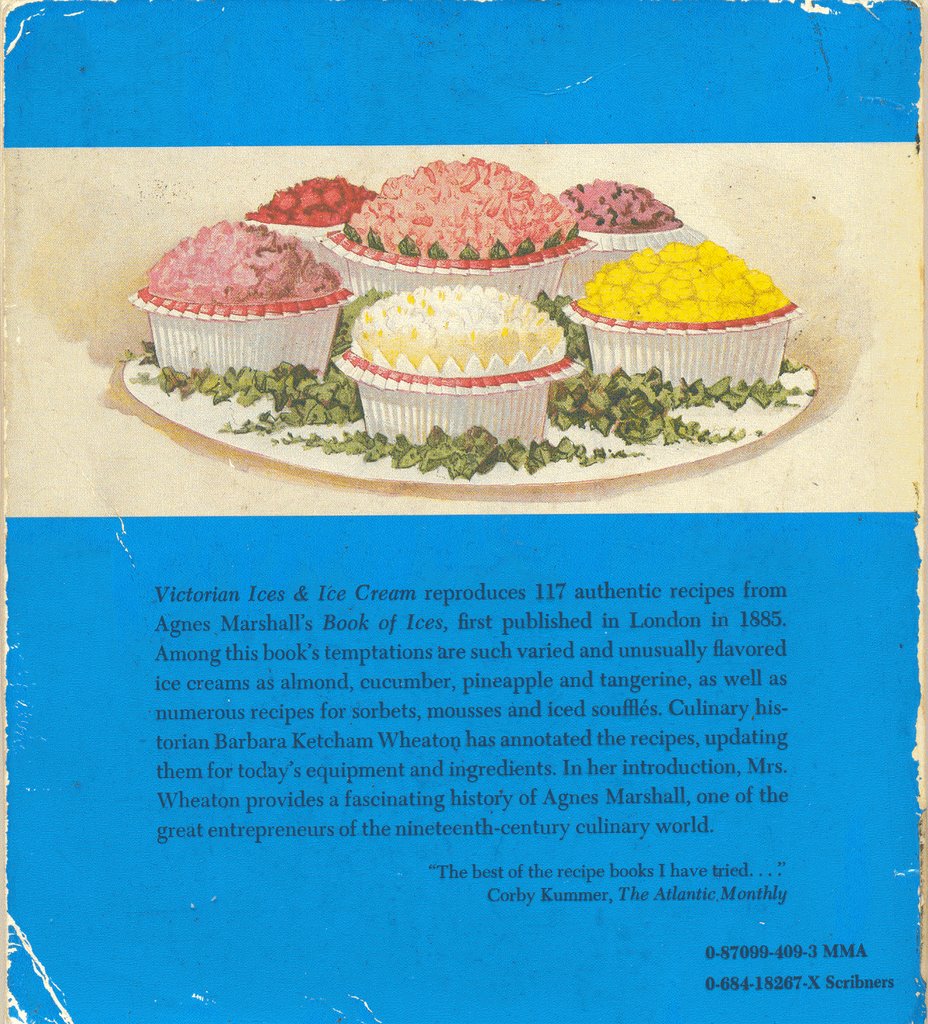 I found this at the library. The title in full is Victorian Ices & Ice Cream: 117 Delicious and Unusual Recipes Updated for the Modern Kitchen: Original Recipes from The Book of Ices by A.B. Marshall, London, 1885. A reprint of The Book of Ices (London: Marshall's School of Cookery, 1885) by Agnes B. Marshall, this edition was published in 1976 by The Metropolitan Museum of Art and Charles Scribner's Sons. The introduction and annotations are by Barbara Ketcham Wheaton and the foreword is by A. Hyatt Mayor.