Out in the public arena, people frequently twang on me for being "Mister Gloom'n'doom," or for "not offering any solutions." I find this bizarre because I never fail to present audiences with a long, explicit task list of projects that American society needs to take up in the face of the combined problems I have labeled The Long Emergency. That the audience never hears this, and then indignantly demands such instruction, only reinforces my sense that the cognitive dissonance in our culture has gone totally off the charts.
Insofar as I just returned from a college lecture road trip, and heard the same carping all over again, I conclude that it's necessary for me to spell it all out a'fresh. I think of this not so much as a roster of "solutions" but as a set of reasonable responses to a new set of circumstances. (Not everything we try to do will succeed, that is, be a "solution.") So, for those of you who are tired of wringing your hands, who would like to do something useful, or focus your attention in a purposeful way, here it is.
...The bottom line of this is: start thinking beyond the car. We have to make other arrangements for virtually all the common activities of daily life.
We have to produce food differently. The ADM / Monsanto / Cargill model of industrial agribusiness is heading toward its Waterloo. As oil and gas deplete, we will be left with sterile soils and farming organized at an unworkable scale. Many lives will depend on our ability to fix this. Farming will soon return much closer to the center of American economic life. It will necessarily have to be done more locally, at a smaller-and-finer scale, and will require more human labor. The value-added activities associated with farming -- e.g. making products like cheese, wine, oils -- will also have to be done much more locally. This situation presents excellent business and vocational opportunities for America's young people (if they can unplug their Ipods long enough to pay attention.) It also presents huge problems in land-use reform. Not to mention the fact that the knowledge and skill for doing these things has to be painstakingly retrieved from the dumpster of history. Get busy.
...
We have to move things and people differently. This is the sunset of Happy Motoring (including the entire US trucking system). Get used to it. Don't waste your society's remaining resources trying to prop up car-and-truck dependency. Moving things and people by water and rail is vastly more energy-efficient....Right now, programs are underway to restore maritime shipping based on wind -- yes, sailing ships. It's for real. Lots to do here. Put down your Ipod and get busy.
We have to transform retail trade. The national chains that have used the high tide of fossil fuels to contrive predatory economies-of-scale (and kill local economies) -- they are going down. WalMart and the other outfits will not survive the coming era of expensive, scarcer oil. They will not be able to run the "warehouses-on-wheels" of 18-wheel tractor-trailers incessantly circulating along the interstate highways. Their 12,000-mile supply lines to the Asian slave-factories are also endangered as the US and China contest for Middle East and African oil. The local networks of commercial interdependency which these chain stores systematically destroyed (with the public's acquiescence) will have to be rebuilt brick-by-brick and inventory-by-inventory. This will require rich, fine-grained, multi-layered networks of people who make, distribute, and sell stuff (including the much-maligned "middlemen"). Don't be fooled into thinking that the Internet will replace local retail economies. Internet shopping is totally dependent now on cheap delivery, and delivery will no longer be cheap. It also is predicated on electric power systems that are completely reliable. That is something we are unlikely to enjoy in the years ahead. Do you have a penchant for retail trade and don't want to work for a big predatory corporation? There's lots to do here in the realm of small, local business. Quit carping and get busy.
We will have to make things again in America. However, we are going to make less stuff....We're going to have to make things on a smaller scale by other means. Perhaps we will have to use more water power. The truth is, we don't know yet how we're going to make anything. This is something that the younger generations can put their minds and muscles into.
The age of canned entertainment is coming to and [sic] end. It was fun for a while. We liked "Citizen Kane" and the Beatles. But we're going to have to make our own music and our own drama down the road. We're going to need playhouses and live performance halls. We're going to need violin and banjo players and playwrights and scenery-makers, and singers. We'll need theater managers and stage-hands. The Internet is not going to save canned entertainment. The Internet will not work so well if the electricity is on the fritz half the time (or more).
We'll have to reorganize the education system. The centralized secondary school systems based on the yellow school bus fleets will not survive the coming decades. The huge investments we have made in these facilities will impede the transition out of them, but they will fail anyway. Since we will be a less-affluent society, we probably won't be able to replace these centralized facilities with smaller and more equitably distributed schools, at least not right away. Personally, I believe that the next incarnation of education will grow out of the home schooling movement, as home schooling efforts aggregate locally into units of more than one family. God knows what happens beyond secondary ed. The big universities, both public and private, may not be salvageable. And the activity of higher ed itself may engender huge resentment by those foreclosed from it. But anyone who learns to do long division and write a coherent paragraph will be at a great advantage -- and, in any case, will probably out-perform today's average college graduate. One thing for sure: teaching children is not liable to become an obsolete line-of-work, as compared to public relations and sports marketing....
We have to reorganize the medical system. The current skein of intertwined rackets based on endless Ponzi buck passing scams will not survive the discontinuities to come. We will probably have to return to a model of service much closer to what used to be called "doctoring." Medical training may also have to change as the big universities run into trouble functioning. Doctors of the 21st century will certainly drive fewer German cars, and there will be fewer opportunities in the cosmetic surgery field. Let's hope that we don't slide so far back that we forget the germ theory of disease, or the need to wash our hands, or the fundamentals of pharmaceutical science. Lots to do here for the unsqueamish.
Life in the USA will have to become much more local, and virtually all the activities of everyday life will have to be re-scaled. You can state categorically that any enterprise now supersized is likely to fail -- everything from the federal government to big corporations to huge institutions. If you can find a way to do something practical and useful on a smaller scale than it is currently being done, you are likely to have food in your cupboard and people who esteem you. An entire social infrastructure of voluntary associations, co-opted by the narcotic of television, needs to be reconstructed. Local institutions for care of the helpless will have to be organized. Local politics will be much more meaningful as state governments and federal agencies slide into complete impotence. Lots of jobs here for local heroes.
So, that's the task list for now. Forgive me if I left things out. But please don't carp at me, by letter or in person, that I am not providing you with anything to think about or devote your personal energy to. If you're depressed, change your focus. Quit wishing and start doing. The best way to feel hopeful about the future is to ... demonstrate to yourself that you are a capable, competent individual resolutely able to face new circumstances.
Monday, February 05, 2007


Tuesday, January 30, 2007
Making Other Arrangements
http://www.orionmagazine.org/pages/om/07-1om/Kunstler.html
Excerpts therefrom:
There may be other ways of moving things above the ground, for instance balloons, blimps, or zeppelin-type airships. But they will move much more slowly and carry far less cargo and human passengers than the airplanes we've been enjoying for the past sixty years or so. The most likely scenario in the years ahead is that aviation will become an increasingly expensive, elite activity as the oil age dribbles to a close, and then it will not exist at all.
We have to do better. We have to start right away making those other arrangements. We have to begin the transition to some mode of living that will allow us to carry on the project of civilization—and I would argue against the notion advanced by Daniel Quinn and others that civilization itself is our enemy and should not be continued. The agenda for facing our problems squarely can, in fact, be described with some precision. We have to make other arrangements for the basic activities of everyday life.
In general, the circumstances we face with energy and climate change will require us to live much more locally, probably profoundly and intensely so. We have to grow more of our food locally, on a smaller scale than we do now, with fewer artificial "inputs," and probably with more human and animal labor. Farming may come closer to the center of our national economic life than it has been within the memory of anyone alive now. These changes are also likely to revive a menu of social and class conflicts that we also thought we had left behind.
The automobile will be a diminishing presence in our lives and, increasingly, a luxury that will be resented by those who can no longer afford to participate in the "happy motoring" utopia. The interstate highways themselves will require more resources to maintain than we will be able to muster. For many of us, the twenty-first century will be less about incessant mobility than about staying where we are.
We have to inhabit the terrain of North America differently, meaning a return to traditional cities, towns, neighborhoods, and a productive rural landscape that is more than just strictly scenic or recreational. We will probably see a reversal of the two-hundred-year-long trend of people moving from the country and small towns to the big cities. In fact, our big cities will probably contract substantially, even while they re-densify at their centers and along their waterfronts.
It is harder to predict exactly what may happen with education and medicine, except to say that neither can continue to operate as rackets much longer, and that they, like everything else, will have to become smaller in scale and much more local. Our centralized school districts, utterly dependent on the countless daily trips of fleets of yellow buses and oppressive property taxes, have poor prospects for carrying on successfully in an energy-scarce economy. However, we will be a less affluent nation in the post-oil age, and therefore may be hard-pressed to replace them. A new, more locally based education system may arise instead out of home-schooling, as household classes aggregate into new, small, neighborhood schools. College will cease to be a mass-consumer activity, and may only be available to social elites—if it continues to exist at all. Meanwhile, we're in for a pretty stark era of triage as the vast resources of the "medical industry" contract. Even without a global energy crisis bearing down on us, the federal Medicaid and Medicare systems would not survive the future as currently funded.
As a matter of fact, you can state categorically that anything organized on a gigantic scale, whether it is a federal government or the Acme Corporation or the University of Michigan, will probably falter in the energy-scarce future. Therefore, don't pin your hopes on multinational corporations, international NGOs, or any other giant organizations or institutions.
Recent events have caused many of us to fear that we are headed toward a Big Brother kind of governmental tyranny. I think we will be lucky if the federal government can answer the phones, let alone regulate anyone's life, in the post-oil era. As power devolves to the local and regional level, the very purpose of our federal arrangements may come into question. The state governments, with their enormous bureaucracies, may not be better off. Further along in this century, the real political action will likely shift down to the local level, as reconstructed neighborly associations allow people to tackle problems locally with local solutions.
Excerpts therefrom:
There may be other ways of moving things above the ground, for instance balloons, blimps, or zeppelin-type airships. But they will move much more slowly and carry far less cargo and human passengers than the airplanes we've been enjoying for the past sixty years or so. The most likely scenario in the years ahead is that aviation will become an increasingly expensive, elite activity as the oil age dribbles to a close, and then it will not exist at all.
We have to do better. We have to start right away making those other arrangements. We have to begin the transition to some mode of living that will allow us to carry on the project of civilization—and I would argue against the notion advanced by Daniel Quinn and others that civilization itself is our enemy and should not be continued. The agenda for facing our problems squarely can, in fact, be described with some precision. We have to make other arrangements for the basic activities of everyday life.
In general, the circumstances we face with energy and climate change will require us to live much more locally, probably profoundly and intensely so. We have to grow more of our food locally, on a smaller scale than we do now, with fewer artificial "inputs," and probably with more human and animal labor. Farming may come closer to the center of our national economic life than it has been within the memory of anyone alive now. These changes are also likely to revive a menu of social and class conflicts that we also thought we had left behind.
The automobile will be a diminishing presence in our lives and, increasingly, a luxury that will be resented by those who can no longer afford to participate in the "happy motoring" utopia. The interstate highways themselves will require more resources to maintain than we will be able to muster. For many of us, the twenty-first century will be less about incessant mobility than about staying where we are.
We have to inhabit the terrain of North America differently, meaning a return to traditional cities, towns, neighborhoods, and a productive rural landscape that is more than just strictly scenic or recreational. We will probably see a reversal of the two-hundred-year-long trend of people moving from the country and small towns to the big cities. In fact, our big cities will probably contract substantially, even while they re-densify at their centers and along their waterfronts.
It is harder to predict exactly what may happen with education and medicine, except to say that neither can continue to operate as rackets much longer, and that they, like everything else, will have to become smaller in scale and much more local. Our centralized school districts, utterly dependent on the countless daily trips of fleets of yellow buses and oppressive property taxes, have poor prospects for carrying on successfully in an energy-scarce economy. However, we will be a less affluent nation in the post-oil age, and therefore may be hard-pressed to replace them. A new, more locally based education system may arise instead out of home-schooling, as household classes aggregate into new, small, neighborhood schools. College will cease to be a mass-consumer activity, and may only be available to social elites—if it continues to exist at all. Meanwhile, we're in for a pretty stark era of triage as the vast resources of the "medical industry" contract. Even without a global energy crisis bearing down on us, the federal Medicaid and Medicare systems would not survive the future as currently funded.
As a matter of fact, you can state categorically that anything organized on a gigantic scale, whether it is a federal government or the Acme Corporation or the University of Michigan, will probably falter in the energy-scarce future. Therefore, don't pin your hopes on multinational corporations, international NGOs, or any other giant organizations or institutions.
Recent events have caused many of us to fear that we are headed toward a Big Brother kind of governmental tyranny. I think we will be lucky if the federal government can answer the phones, let alone regulate anyone's life, in the post-oil era. As power devolves to the local and regional level, the very purpose of our federal arrangements may come into question. The state governments, with their enormous bureaucracies, may not be better off. Further along in this century, the real political action will likely shift down to the local level, as reconstructed neighborly associations allow people to tackle problems locally with local solutions.
Wednesday, January 24, 2007
Friday, January 19, 2007
Monday, January 15, 2007
New Found Blogs
Ilind.net today mentions a blog by Oahu-based historian and UH-Manoa professor Dr. Andrew Wertheimer. "Dr. Drew" writes mainly about the histories of libraries and Japanese-Americans. Ilind also points its readers to "SusHI" or Sustainability in Hawai'i, a blog by Ken Stokes.
One key phrase for a journalist: quietly disclosed
One key phrase for a journalist: quietly disclosed
Monday, January 08, 2007
| Greed: | Very Low | |
| Gluttony: | Low | |
| Wrath: | Low | |
| Sloth: | Medium | |
| Envy: | Very Low | |
| Lust: | Very Low | |
| Pride: | Medium |
Take the Seven Deadly Sins Quiz
Friday, January 05, 2007
Happy New Year, Part One
 The first movie I saw this year was Hibari no Hanadata Tantei Gassen (1958). I fell asleep about 10:15 New Year's Eve and woke up about 12:15 a.m. The TV was on NGN3, which plays Japanese movies. It was fifteen minutes into the movie, which played from 12 to 1:35 a.m. (Every New Year's our cable company has a free preview of Nippon Golden Network, which plays over three channels. During this time people can sign up for NGN at a discount, which is what we did this week) I watched about thirty minutes before falling asleep again.
Much later, from 4 to 5:35 p.m., the movie played again. I missed the first ten minutes but watched it until the end.
Also known as Detective Duel, Hibari is both a romantic comedy and mystery about two detectives competing to solve the case of a missing woman. Yukiko (played by Misora Hibari) is a sleuth up against the more experienced gumshoe Mitamura Eiji (Takakura Ken).* They tease each other but soon unite to solve the case of a missing woman, and thwart an intricate plot against her. (*In Japanese custom, surnames are placed before given names; e.g., Takakura Ken.)
Tuesday, January 02, 2007
Kunstler's Predictions
Like Janus, Kunstler simultaneously looks back at 2006 and ahead at 2007. He concludes a lengthy but worthwhile post with this:
To sum it all up, I believe 2007 will be the year that the US finally feels the pain. More disorder will appear in the system. More cries of anguish will be heard throughout the land. More paralysis will set in. The bid for leadership may not follow the current story line -- Barack...Hillary...Edwards...McCain...blah blah blah. Jokers and wild cards could step into the frame. America will be looking for a man on a white horse and instead they'll get Newt Gingrich on an electric Humvee.
To sum it all up, I believe 2007 will be the year that the US finally feels the pain. More disorder will appear in the system. More cries of anguish will be heard throughout the land. More paralysis will set in. The bid for leadership may not follow the current story line -- Barack...Hillary...Edwards...McCain...blah blah blah. Jokers and wild cards could step into the frame. America will be looking for a man on a white horse and instead they'll get Newt Gingrich on an electric Humvee.
Thursday, December 28, 2006
Saturday, December 16, 2006
Thursday, December 14, 2006
Wednesday, December 13, 2006
Ten Newspaper Design Myths, Debunked
http://www.poynter.org/content/content_view.asp?id=4091
10 Universal Newspaper Design Myths, Debunked
By Mario Garcia (more by author) Poynter Affiliate
E-mail this item Print this Page Add/View Comments on this Article (1)
My diary entries contain travelogues, agendas, and occasionally, the graffiti of design myths. I always write these myths in red, to make sure I do not forget them. I must have more than 150 that I have listed during 20 years of traveling, but there are 10 that have become the "Super Myths," those that transcend nationalities, ethnicity, or language. I offer them as a checklist to see how many of them are part of your own myth repertoire:
1. Don't run headlines next to each other. "Bumping headlines" should be ranked as the No. 1 design myth, especially in the United States. I am certain that more time is spent in newsrooms everywhere designing pages that avoid headlines coming together than actually writing better headlines. As a veteran of hundreds of focus groups that were shown pages with headlines that sometimes bumped, I have yet to hear a reader anywhere echo the complaint about "bumping headlines." Of course, I am not an advocate of bumped headlines. However, I am suggesting that we should not spend unnecessary time and effort avoiding what seems to affect no one but the editor and his old journalism school professor.
2. Readers don't like reversed out type. Well, many editors don't. And I am sure that readers would probably find it unusual and hard to read if an entire article were set in white type against a black or color background. However, a few lines of a quote or a highlight set against a dark background will not affect legibility as long as the type size is larger than normal and the interline spacing is adequate.
3. Color must be introduced slowly. Life is in color. Attempts at a slow introduction of color in a newspaper that may have been entirely black and white for years are quite exaggerated. In this regard, one must respect the editors' knowledge of their own communities and their readers' ability to assimilate change. However, my own experience has been that color is almost always extremely well received, and that readers in most communities no longer attach the label of "less serious" to newspapers that print in color. Specifically with 25- to 35-year-old readers, color is an expectation more than an abomination. What is important, and this must be emphasized, is that color use be appropriate for the newspaper and its community.
4. Italics are difficult to read. I have heard this more than 500 times, from South America to South Africa, and in Malaysia, too! Every editor seems to have a built-in catalog of anecdotes to illustrate why italics should never be used. They are supposed to be "feminine"; therefore, why use them in the macho sports section? They are "strange" to the reader and imply soft news, as opposed to hard news, so relegate them to the gardening page. And, last, italics slow down the reading, so avoid them in text. The truth? Italics are unisex. A feature in sports can wear italics well, but so can that souffle story in the food section. The soft-versus-hard implication is an American phenomenon, I must admit. A banner headline in a strong italic font played large will be able to do the job as well as a Roman headline. Size and boldness and the distinction of the type used are more significant than whether the type is italic. Contrast italics with Roman type, or bolder or lighter type nearby, and they make that souffle rise on the page. Add them as a secondary line under a classic Roman face, and there is music on the page. Give the name on the byline an italic touch, and somehow the visual rhythm of the text may be altered for the better.
5. Don't mix color and black-and-white photos or graphics on the same page. Never once have I heard a reader complain about this special cocktail of mixed black-and-white and color images. The designer's task is to select the best possible images, regardless of color, and display them properly on the page following a hierarchy that indicates where the eye should go first, second, and third. The color versus black-and-white issue becomes quite secondary to the content of the images, their placement on the page, and the role of the images in the overall design.
6. Don't interrupt the flow of text. Magazines have been using quotes, highlights, and other text breakers for years. However, place one of these devices in the text of many newspapers and you will find a chorus of editors repeating the same verse: Any interruption of text causes the reader to stop reading. I have found no evidence of this in the many focus groups I have observed or in The Poynter Institute's own EYE-TRAC Research. (EYE-TRAC scientifically documented how color, text, graphics, and photos direct a reader's eyes around a newspaper page.) Of course, interruptions can become obstacle courses if: - One places a 24-line quote across 12 picas, forcing the reader to jump over text; or - One places the breaker in such a strategic position that the reader will not jump over it, but assumes instead that he should move across to the adjacent column. So length of the interruption and its placement determine legibility factors. Any interruption that requires more than a 2-1/2 inch jump should be reconsidered.
7. Readers prefer justified type over ragged-right type. The myth is that ragged-right type implies "soft" or feature material, while justified type represents serious hard news. This, too, is only in the minds of editors and some designers. There is no evidence of the truth to this perception. If newspapers had always set all their text ragged right, readers would have accepted that style. Ragged-right type can change the rhythm on the page, even when used for short texts or for columnists. Its use incorporates white space, which is always needed, and allows for more appropriate letter spacing within and between words. Some research has confirmed that the presence of ragged right speeds up reading.
8. Story count counts. One must have, says this myth, a minimum of five stories on the front page. Well, it is seven in some newspapers, and 11 in others. Story count is a state of mind; it should not be a formula. No two days in the news are alike for the editor putting together Page One. On certain days, one big story may equal four, or even seven, small ones. Sometimes a photo may carry the weight of 10 stories, and so on. Individual elements are what count, not a systematic formula that forces elements to satisfy a quota on the page. What do we know about story count and Page One? Well, the front page is still the face of the newspaper and must display not only the day's news but promote the best content inside. More is definitely better than less, and index items, promo boxes, and even standalone photos are all part of what makes the eye move. Readers in focus groups do not count stories. Eye movement - activity on the canvas of the page - is what counts. How one makes the readers' eyes move can be determined by factors that are not necessarily associated with the mythical story counts that editors are subjected to.
9. Leave things in the same place every day. For many editors, a Page One or a section front with static elements (promos at the top, left-hand column of briefs, etc.) provides a sort of teddy bear to embrace when they come to work every day. So, in typical fashion, editors always ask for the teddy bears. There is no truth to the myth that readers want these elements exactly in the same places every day. I prefer to experiment with "teddy bears on roller skates" - let the promo boxes appear differently from day to day. Some days use one promo only, some days use three promos. Surprise the reader with promos that run vertically on Tuesday, but horizontally on Wednesday.
10. The lead story must always appear on the right-hand side of the page. Editors seem sure of this, but nobody bothered to tell the readers. To them, the lead story is the one with the biggest and boldest headline, whether it is to the right or the left. Of course, hierarchy is important. No myth here. One definitive lead must appear on the page to guide the reader, but its appearance, as long as it is above the fold, becomes inconsequential. Why the myths? Well, what would newspapers be without them? Meetings would be shorter, and less argumentative, especially if there was no "italics" myth. Who creates the myths? Like the games children play, nobody knows where these myths start. Children teach each other games in the schoolyard; professors pass on myths to their innocent charges in journalism school. Then those myths gain momentum when the rookie journalist hears the same myth glorified by his veteran editor, and so on. What can one do about myths? Select the ones you really want to do battle over, then wrestle the myth promoter to the ground. Sometimes you win.
10 Universal Newspaper Design Myths, Debunked
By Mario Garcia (more by author) Poynter Affiliate
E-mail this item Print this Page Add/View Comments on this Article (1)
My diary entries contain travelogues, agendas, and occasionally, the graffiti of design myths. I always write these myths in red, to make sure I do not forget them. I must have more than 150 that I have listed during 20 years of traveling, but there are 10 that have become the "Super Myths," those that transcend nationalities, ethnicity, or language. I offer them as a checklist to see how many of them are part of your own myth repertoire:
1. Don't run headlines next to each other. "Bumping headlines" should be ranked as the No. 1 design myth, especially in the United States. I am certain that more time is spent in newsrooms everywhere designing pages that avoid headlines coming together than actually writing better headlines. As a veteran of hundreds of focus groups that were shown pages with headlines that sometimes bumped, I have yet to hear a reader anywhere echo the complaint about "bumping headlines." Of course, I am not an advocate of bumped headlines. However, I am suggesting that we should not spend unnecessary time and effort avoiding what seems to affect no one but the editor and his old journalism school professor.
2. Readers don't like reversed out type. Well, many editors don't. And I am sure that readers would probably find it unusual and hard to read if an entire article were set in white type against a black or color background. However, a few lines of a quote or a highlight set against a dark background will not affect legibility as long as the type size is larger than normal and the interline spacing is adequate.
3. Color must be introduced slowly. Life is in color. Attempts at a slow introduction of color in a newspaper that may have been entirely black and white for years are quite exaggerated. In this regard, one must respect the editors' knowledge of their own communities and their readers' ability to assimilate change. However, my own experience has been that color is almost always extremely well received, and that readers in most communities no longer attach the label of "less serious" to newspapers that print in color. Specifically with 25- to 35-year-old readers, color is an expectation more than an abomination. What is important, and this must be emphasized, is that color use be appropriate for the newspaper and its community.
4. Italics are difficult to read. I have heard this more than 500 times, from South America to South Africa, and in Malaysia, too! Every editor seems to have a built-in catalog of anecdotes to illustrate why italics should never be used. They are supposed to be "feminine"; therefore, why use them in the macho sports section? They are "strange" to the reader and imply soft news, as opposed to hard news, so relegate them to the gardening page. And, last, italics slow down the reading, so avoid them in text. The truth? Italics are unisex. A feature in sports can wear italics well, but so can that souffle story in the food section. The soft-versus-hard implication is an American phenomenon, I must admit. A banner headline in a strong italic font played large will be able to do the job as well as a Roman headline. Size and boldness and the distinction of the type used are more significant than whether the type is italic. Contrast italics with Roman type, or bolder or lighter type nearby, and they make that souffle rise on the page. Add them as a secondary line under a classic Roman face, and there is music on the page. Give the name on the byline an italic touch, and somehow the visual rhythm of the text may be altered for the better.
5. Don't mix color and black-and-white photos or graphics on the same page. Never once have I heard a reader complain about this special cocktail of mixed black-and-white and color images. The designer's task is to select the best possible images, regardless of color, and display them properly on the page following a hierarchy that indicates where the eye should go first, second, and third. The color versus black-and-white issue becomes quite secondary to the content of the images, their placement on the page, and the role of the images in the overall design.
6. Don't interrupt the flow of text. Magazines have been using quotes, highlights, and other text breakers for years. However, place one of these devices in the text of many newspapers and you will find a chorus of editors repeating the same verse: Any interruption of text causes the reader to stop reading. I have found no evidence of this in the many focus groups I have observed or in The Poynter Institute's own EYE-TRAC Research. (EYE-TRAC scientifically documented how color, text, graphics, and photos direct a reader's eyes around a newspaper page.) Of course, interruptions can become obstacle courses if: - One places a 24-line quote across 12 picas, forcing the reader to jump over text; or - One places the breaker in such a strategic position that the reader will not jump over it, but assumes instead that he should move across to the adjacent column. So length of the interruption and its placement determine legibility factors. Any interruption that requires more than a 2-1/2 inch jump should be reconsidered.
7. Readers prefer justified type over ragged-right type. The myth is that ragged-right type implies "soft" or feature material, while justified type represents serious hard news. This, too, is only in the minds of editors and some designers. There is no evidence of the truth to this perception. If newspapers had always set all their text ragged right, readers would have accepted that style. Ragged-right type can change the rhythm on the page, even when used for short texts or for columnists. Its use incorporates white space, which is always needed, and allows for more appropriate letter spacing within and between words. Some research has confirmed that the presence of ragged right speeds up reading.
8. Story count counts. One must have, says this myth, a minimum of five stories on the front page. Well, it is seven in some newspapers, and 11 in others. Story count is a state of mind; it should not be a formula. No two days in the news are alike for the editor putting together Page One. On certain days, one big story may equal four, or even seven, small ones. Sometimes a photo may carry the weight of 10 stories, and so on. Individual elements are what count, not a systematic formula that forces elements to satisfy a quota on the page. What do we know about story count and Page One? Well, the front page is still the face of the newspaper and must display not only the day's news but promote the best content inside. More is definitely better than less, and index items, promo boxes, and even standalone photos are all part of what makes the eye move. Readers in focus groups do not count stories. Eye movement - activity on the canvas of the page - is what counts. How one makes the readers' eyes move can be determined by factors that are not necessarily associated with the mythical story counts that editors are subjected to.
9. Leave things in the same place every day. For many editors, a Page One or a section front with static elements (promos at the top, left-hand column of briefs, etc.) provides a sort of teddy bear to embrace when they come to work every day. So, in typical fashion, editors always ask for the teddy bears. There is no truth to the myth that readers want these elements exactly in the same places every day. I prefer to experiment with "teddy bears on roller skates" - let the promo boxes appear differently from day to day. Some days use one promo only, some days use three promos. Surprise the reader with promos that run vertically on Tuesday, but horizontally on Wednesday.
10. The lead story must always appear on the right-hand side of the page. Editors seem sure of this, but nobody bothered to tell the readers. To them, the lead story is the one with the biggest and boldest headline, whether it is to the right or the left. Of course, hierarchy is important. No myth here. One definitive lead must appear on the page to guide the reader, but its appearance, as long as it is above the fold, becomes inconsequential. Why the myths? Well, what would newspapers be without them? Meetings would be shorter, and less argumentative, especially if there was no "italics" myth. Who creates the myths? Like the games children play, nobody knows where these myths start. Children teach each other games in the schoolyard; professors pass on myths to their innocent charges in journalism school. Then those myths gain momentum when the rookie journalist hears the same myth glorified by his veteran editor, and so on. What can one do about myths? Select the ones you really want to do battle over, then wrestle the myth promoter to the ground. Sometimes you win.
Tuesday, December 12, 2006
Christmas Every Day
William Dean Howells wrote what would happen.
THE little girl came into her papa's study, as she always did Saturday morning before breakfast, and asked for a story. He tried to beg off that morning, for he was very busy, but she would not let him. So he began:
"Well, once there was a little pig--"
She stopped him at the word. She said she had heard little pig-stories till she was perfectly sick of them.
"Well, what kind of story shall I tell, then?"
"About Christmas. It's getting to be the season."
"Well!" Her papa roused himself. "Then I'll tell you about the little girl that wanted it Christmas every day in the year. How would you like that?"
"First-rate!" said the little girl; and she nestled into comfortable shape in his lap, ready for listening.
"Very well, then, this little pig--Oh, what are you pounding me for?"
"Because you said little pig instead of little girl."
"I should like to know what's the difference between a little pig and a little girl that wanted it Christmas every day!"
"Papa!" said the little girl warningly. At this her papa began to tell the story.
THE little girl came into her papa's study, as she always did Saturday morning before breakfast, and asked for a story. He tried to beg off that morning, for he was very busy, but she would not let him. So he began:
"Well, once there was a little pig--"
She stopped him at the word. She said she had heard little pig-stories till she was perfectly sick of them.
"Well, what kind of story shall I tell, then?"
"About Christmas. It's getting to be the season."
"Well!" Her papa roused himself. "Then I'll tell you about the little girl that wanted it Christmas every day in the year. How would you like that?"
"First-rate!" said the little girl; and she nestled into comfortable shape in his lap, ready for listening.
"Very well, then, this little pig--Oh, what are you pounding me for?"
"Because you said little pig instead of little girl."
"I should like to know what's the difference between a little pig and a little girl that wanted it Christmas every day!"
"Papa!" said the little girl warningly. At this her papa began to tell the story.
Monday, December 11, 2006
A Brief Descent into Vulgarity
Defintion five of the entry for "hard-on" at UrbanDictionary.com
5.
hard-on
13 up, 16 down
(alternate spelling of hardon)1. An erection 2. A problemAlthough definition 1 is far more common, 2 is occasionally used. It is used with "for", as in "Having a hard-on for..." It implies an unhealthy fixation, and it is pejorative, in that (obviously) it implies a homoerotic obsession.
Ever since I got Jim fired, he's had a real hard-on for me.Stop picking on him! Why do you have such a hard-on for him anyway, dude?
by pimpassamir Aug 16, 2004 email it
---------------
What would Alicublog do without Rod Dreher or Ilind without Ed Case?
5.
hard-on
13 up, 16 down
(alternate spelling of hardon)1. An erection 2. A problemAlthough definition 1 is far more common, 2 is occasionally used. It is used with "for", as in "Having a hard-on for..." It implies an unhealthy fixation, and it is pejorative, in that (obviously) it implies a homoerotic obsession.
Ever since I got Jim fired, he's had a real hard-on for me.Stop picking on him! Why do you have such a hard-on for him anyway, dude?
by pimpassamir Aug 16, 2004 email it
---------------
What would Alicublog do without Rod Dreher or Ilind without Ed Case?
Friday, December 08, 2006
Rare Cookbooks, Part Two

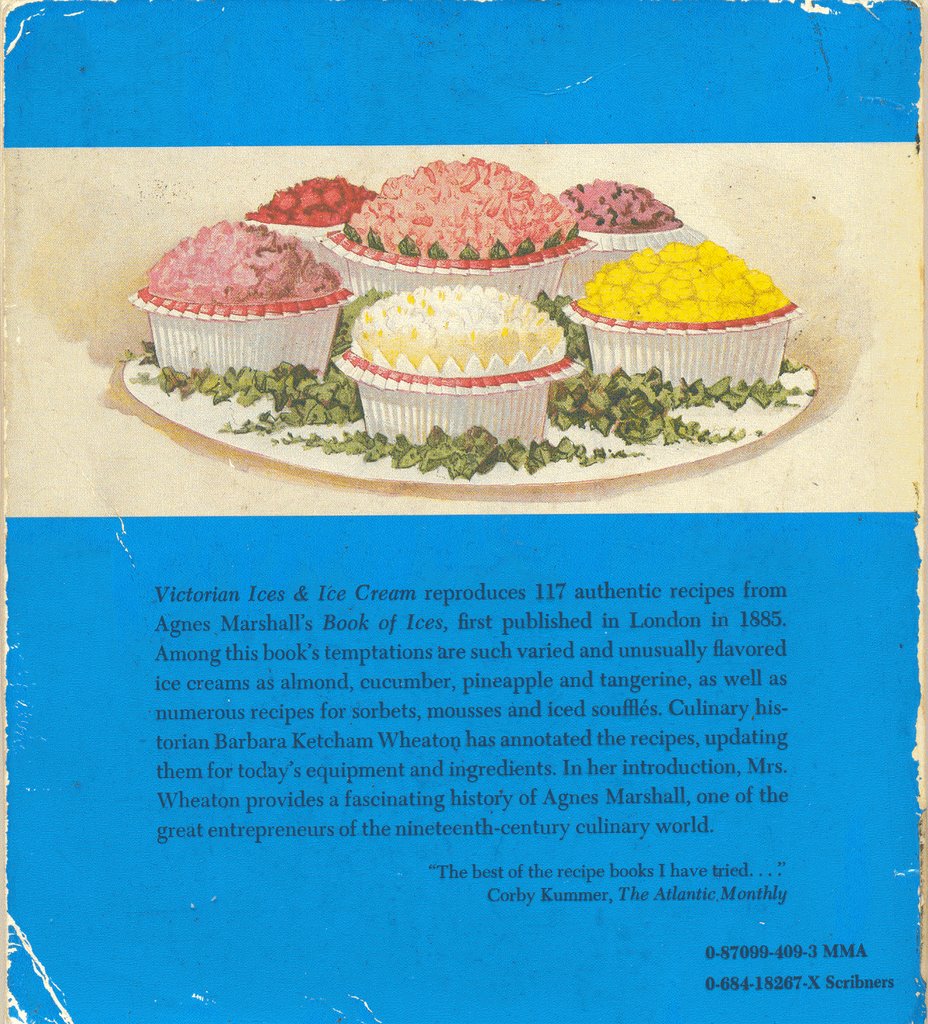 I found this at the library. The title in full is Victorian Ices & Ice Cream: 117 Delicious and Unusual Recipes Updated for the Modern Kitchen: Original Recipes from The Book of Ices by A.B. Marshall, London, 1885. A reprint of The Book of Ices (London: Marshall's School of Cookery, 1885) by Agnes B. Marshall, this edition was published in 1976 by The Metropolitan Museum of Art and Charles Scribner's Sons. The introduction and annotations are by Barbara Ketcham Wheaton and the foreword is by A. Hyatt Mayor.
-----
December 10 update: On a related note, Rose Vesel Mattus, the co-founder of Haagen-Dazs, has died. In 2004 she wrote The Emperor of Ice Cream: The True Story of Haagen-Dazs.
The Notability Criterion of Wikipedia
is what this Washington Post article addresses. Wikidumper rescues articles deleted from Wikipedia. This is another blog about Wikipedia, from a sociological perspective.
Tuesday, December 05, 2006
Vandalism in Canada

Kunstler's Eyesore of the Month for December
"The new addition to the Royal Ontario Museum, Toronto, by Daniel Libeskind-- scoring a two-in-a-row coup for the architect/savant on EOTM. Why are all those people standing around in the foreground gaping at this spectacle? They are from the Royal College of Physicians, trying to figure out a treatment plan. The stuffy old gentleman of a museum has developed a horrendous steel and glass tumor. It has become the "Elephant Man" of museums. Now, you may ask yourself: why is this sort of thing acceptable to the Guardians of Culture? The answer may be that it sends a truthful but subliminal message (which, alas, we are misinterpreting) that the mis-use of technology has become the fatal disease of civilization."
Kunstler also has a link to Dmitri Orlov's report on how the Soviet Union/Russia weathered its economic collapse.
Monday, December 04, 2006
Same As It Ever Was
Hunter Bishop notes that trouble is brewing with the 2006-08 County Council. Pete Hoffman is in charge now. Say what you will about Stacy Higa; at least he was never photographed making this choch facial expression.
Subscribe to:
Posts (Atom)
